Printing Bill
News of the WorldThe Printing Bill is a flashpoint in the novel’s account of Reconstruction-era Texas, where the contested power of the press meets the instability of public authority. It is presented through claims about the Dallas Courier and public money, then reappears as a practical obstacle to Jefferson Kyle Kidd’s hope of returning to the printing trade. The book gives no full account of the bill’s provisions; instead, its significance emerges through political argument, civic disorder, and the uncertain prospect of repeal.
Political Controversy
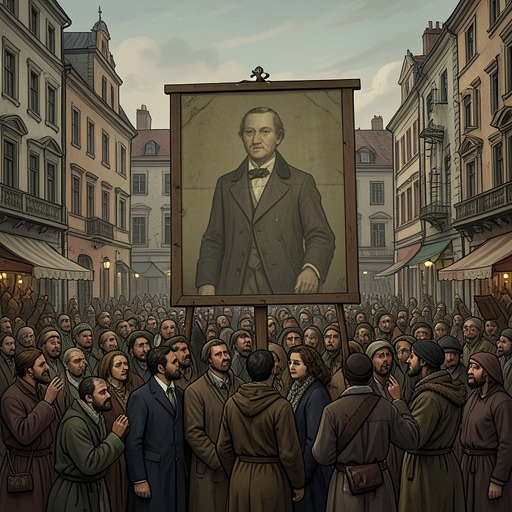
At a public reading in Durand, a man cries that Governor Davis will shut down the Dallas Courier under the Printing Bill, condemning the proposed use of two hundred thousand dollars in tax money to support radical newspapers. The outburst ties the measure to two combustible questions: which newspapers may operate, and whose politics public funds should sustain. The scene presents these points as the speaker’s accusation, not as a detailed explanation of the law or a neutral account of its effects.
The argument rapidly escapes the bounds of discussion. Men shout about the bill alongside accusations against Hamilton and Governor Davis, and the quarrel becomes a fight involving fists, chairs, and a broken commemorative plate. A coin can is overturned and its money trampled; the hanging lanterns swing as people shake the building and force their way into the street. The bill thus appears not as an abstract legislative matter but as one part of a larger political division capable of turning a gathering into a brawl.
A Contested Legal Landscape
The bill belongs to a setting in which legal authority is uncertain and ordinary local government has been disrupted. In Erath County, a group of men tells Kidd that there is no sheriff, justice of the peace, mayor, or board of commissioners: officials associated with the Confederacy have been removed by Governor Davis and the United States Army, and no replacements have been sent. The group claims authority for itself and declares Kidd accountable to them. This episode does not establish that the Printing Bill caused the vacuum, but it shows why disputes about state power and political control carry immediate force in the novel.
Kidd’s earlier encounter with an Army patrol supplies another measure of his distrust. When questioned about his loyalty oath papers, he denies having aided the Confederate Army; he also objects inwardly to what he regards as a corrupt Reconstruction government and a mindless law against carrying handguns. The Printing Bill is one element in this broader atmosphere of rules and authorities that people contest, interpret, or enforce unevenly.
Consequences for Kidd’s Work
The measure also bears on Kidd’s own livelihood. His former print shop in San Antonio is no longer operating as a press: its Stanhope press has been sold and is gone, while the premises hold broken carriage wheels and machinery parts. When Kidd speaks with the lawyer Branholme about adoption, the legal status of returned captives, and the Printing Bill, Branholme says that the bill might be rescinded in a few years, after Governor Davis is gone and the military no longer holds power. Only then, he suggests, might restarting the business be feasible.
That advice makes the bill’s consequence personal without specifying a direct legal order against Kidd’s shop. The future of his trade is bound to political change he cannot control: even the possibility of printing again depends on a reversal in the state’s laws and governing conditions. The book leaves that prospect conditional, not fulfilled, and makes the Printing Bill an emblem of how public policy can reach into private work amid an unsettled transition.